To see top 5 Nexus One Applications CLICK HERE!
Showing posts with label Google Nexus. Show all posts
Showing posts with label Google Nexus. Show all posts
Sunday, January 17, 2010


Friday, January 15, 2010
Nexus One: Too Much Hype, Not Enough Marketing
Poor Nexus One. Despite earning mostly positive reviews and becoming an obsession in the tech blogosphere, the Google phone reportedly sold just 20,000 units in its first week. That's just 10 percent of the Motorola Droid's debut sales.
If those figures are correct -- they're not official, but calculated in a roundabout way by market researcher Flurry -- there a few takeaways as to why the Droid had better early commercial success than the Nexus One. You could argue that in-store Droid sales trump the Nexus One's online-only distribution, or that Verizon Wireless is a bigger carrier than T-Mobile, translating to more potential customers.
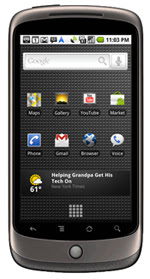 But even if you could buy the Nexus One in stores, and on Verizon Wireless, Google's marketing would still be problematic. Google plans to focus its marketing efforts online, within its own pages, the Wall Street Journal reported. That includes Google home page promotion (though I don't see any at the time of writing this), search ads and a Nexus One channel on YouTube. It's a very Google-like outlook on advertising, where all you need is a little online message here and there to make an impression. Verizon, meanwhile, relentlessly used the Droid to bash the iPhone, and AT&T. It approached the stage with the cockiness of a professional wrestler And it worked.
Google's approach just doesn't stack up. Phones are more than just a purchase. They're your constant companion, probably for two years, and like it or not, they convey a message and a lifestyle. The Droid's lifestyle is that of a manly man who favors function over form, unlike that pretty princess iPhone. The iPhone's image is one of smug satisfaction: Can your phone do this?
Google's in a tough position with the Nexus One, because it can't really knock either of those phones. Obviously attacking another Android phone makes no sense, and iPhone-bashing probably isn't in Google's best interests, because so many Google services -- Search, Maps, YouTube -- are tied up in the iPhone. Verizon can get away with an anti-iPhone campaign, but Google, which is selling the Nexus One directly, cannot.
There's hope for the Nexus One. Perhaps Google's online marketing strategy will be a slow burn, sinking in over many months as word of mouth spreads. Verizon Wireless took the shortcut by bashing the iPhone, but the Nexus One has a long road ahead.
If those figures are correct -- they're not official, but calculated in a roundabout way by market researcher Flurry -- there a few takeaways as to why the Droid had better early commercial success than the Nexus One. You could argue that in-store Droid sales trump the Nexus One's online-only distribution, or that Verizon Wireless is a bigger carrier than T-Mobile, translating to more potential customers.
 But even if you could buy the Nexus One in stores, and on Verizon Wireless, Google's marketing would still be problematic. Google plans to focus its marketing efforts online, within its own pages, the Wall Street Journal reported. That includes Google home page promotion (though I don't see any at the time of writing this), search ads and a Nexus One channel on YouTube. It's a very Google-like outlook on advertising, where all you need is a little online message here and there to make an impression. Verizon, meanwhile, relentlessly used the Droid to bash the iPhone, and AT&T. It approached the stage with the cockiness of a professional wrestler And it worked.
Google's approach just doesn't stack up. Phones are more than just a purchase. They're your constant companion, probably for two years, and like it or not, they convey a message and a lifestyle. The Droid's lifestyle is that of a manly man who favors function over form, unlike that pretty princess iPhone. The iPhone's image is one of smug satisfaction: Can your phone do this?
Google's in a tough position with the Nexus One, because it can't really knock either of those phones. Obviously attacking another Android phone makes no sense, and iPhone-bashing probably isn't in Google's best interests, because so many Google services -- Search, Maps, YouTube -- are tied up in the iPhone. Verizon can get away with an anti-iPhone campaign, but Google, which is selling the Nexus One directly, cannot.
There's hope for the Nexus One. Perhaps Google's online marketing strategy will be a slow burn, sinking in over many months as word of mouth spreads. Verizon Wireless took the shortcut by bashing the iPhone, but the Nexus One has a long road ahead.
Source: PCWORLD
Monday, January 11, 2010
Google Nexus Two is Coming
Google executive Andy Rubin has claimed the next version of the Nexus One will be aimed at enterprise users and could feature a physical keyboard.
 Techtree writes that the follow-up to the Google Nexus One will feature a slide-out Qwerty keyboard, which was the most conspicuous omission from the Nexus One’s design. While it makes sense that Google’s first Android phone ditched the Qwerty – phones without them are a lot easier to keep slim and ‘sexy’ – we always expected that later phones would offer a physical keyboard.
Sunday, January 10, 2010
Google Nexus One Vs. Apple iPhone
Promoting and directly marketing HTC's latest new Android phone under its own brand, Google has taken the fate of its Android smartphone platform into its own hands. How does the new "superphone" mass up to last summer's iPhone 3GS?
AppleInsider has presented a series of articles on how Android stacks up against Apple's iPhone OS as a platform in general terms. In this article, we'll consider the hardware specifics of the latest offering from Google's partner.
Meet your maker
While the tech press likes to say Google designed the Nexus One "with HTC," Google executives clearly gave all the credit to HTC at its introduction, saying "It’s inaccurate to say Google designed the phone. Peter [Chou] and his team [at HTC] built and designed the phone. Google is just marketing and selling the phone."
The phone is nearly identical to what HTC itself sells under the name Bravo in Europe , apart from the placement of its buttons. Google's impact on the Nexus One's specs is far less significant than even Microsoft's original Zune, which while being based on the Toshiba Gigabeat, was at least given a design update and noticeably different software that rendered it incompatible with other PlaysforSure MP3 players. In contrast, the Nexus One is very clearly a Google-branded HTC phone, and there are no intentional, artificial compatibility barriers with other Android platform devices.
HTC has a history of building higher-end PDA-style phones, often with physical keyboards, large screens, and envelope pushing hardware features. Most of its phones have been designed to run Microsoft's Windows Mobile, and are therefore targeted at that platform's core market of IT staff and gadget enthusiasts. HTC has served as Microsoft's primary licensee, building 80% of the Windows Mobile phones to reach the market (although many of these were sold under different brand names, just as Google is now doing with the Nexus One).
The company also built previous generations of PDA-style phones sold by Palm, prior to the debut of the new WebOS-based Pre. But HTC's history as the leading maker of Windows Mobile phones is what positioned it to be the first major manufacture to launch an Android phone, because Google targeted its relatively new Android operating system at hardware reference designs running Windows Mobile, in much the same way that popular desktop distributions of Linux are geared to run on Microsoft's reference design for Windows PCs.
Magic, Dream, Hero, Passion
Google launched Android 1.0 in October 2008 with HTC's Dream (sold as the T-Mobile G1), then followed up with HTC's second generation Magic (the T-Mobile myTouch) last summer, and then the HTC Hero (also sold with slight modifications as the Verizon Droid Eris) last fall. It's therefore nothing out of the ordinary that the newly released Nexus One running Android 2.1 is also being sold under other HTC names in other markets.

Unike earlier HTC models, the new Nexus One does not pair the stock Android OS with HTC's "Sense UI," a user interface theme HTC added to the stock Android both to differentiate its offerings and to solve some rough edges in the Android interface, such as the look of its virtual keyboard. HTC also applies Sense to its Windows Mobile phones which makes HTC's Android phones look and feel more similar to the company's other products than to those of other Android makers, including Motorola's Verizon Droid and the upcoming Sony Ericsson Xperia X10.
Overall, this fractionalization has resulted in making the Android platform less similar to commodity Windows PCs and more like PlaysForSure devices in terms of being unique to their manufacturer rather than offering a largely identical experience between vendors. With Android 2.1 however, Google seems to be signaling the intention to fold in many of HTC's Sense improvements into the standard OS, which should help streamline the platform at the expense of HTC's differentiation.
The Android balancing act
It remains to be seen whether Google will continue to work to neutralize the differentiation efforts of its partners in order to strengthen the Android brand, or whether it will continue to encourage vendors to create their own look and feel independently, as Motorola did with Blur and Sony Ericsson is expected to do with its upcoming phone.
On the other hand, it is in HTC's interests to create reasons for customers to pick its phones over those of other competitors. The company already advertises its Android and Windows Mobile devices under the same ad campaign, direction attention to its own brand rather than to either licensed operating system. Further, at CES the company unveiled a new initiative to release a series of lower-end smartphones based on BREW, Qualcomm's proprietary alternative to Java.
That indicates that despite its shift from Windows Mobile, HTC isn't betting its future on Android. Additionally, it shows that Android itself doesn't do enough to allow phone makers to hit low price points. Successful Android phones require a fast processor and significant RAM and other system resources to be taken seriously.
Finding one operating system to span from the bargain bin to the high end has similarly been a challenge for Nokia, which uses its own simple Nokia OS, the more sophisticated Symbian, a full distro of Maemo Linux in its Internet Tablets, and Windows on its netbook. Samsung has also announced plans to juggle Windows Mobile, Android, and its own Bada platform. Most other makers also have a variety of operating systems, leaving Apple, RIM, and Palm unique in pushing one single OS.
Motorola has announced an intention do to this with Android, but is already facing a rather direct blow from Google and its new branding partnership with HTC. On the other side, Google is also planning to add its new Chrome OS into the mix as a way to enter the significantly different netbook market, which will splinter efforts by its current licensees who already have Android netbooks and tablets under development.
The company has also announced a clear intention to turn its hardware partners into commodity manufacturers, leaving Google with control of all the value across their products, much as Microsoft did to PC makers in the 90s. This is all a precarious balancing act challenge Apple doesn't face.
Android super-Hero
Unlike most of its Windows Mobile phones, which nearly always supply a physical keyboard, HTC's Nexus One builds upon the previous Hero/Droid Eris form factor to deliver something that's closer to the iPhone, but which still supplies a trackball pointer rather than relying on ubiquitous multitouch for navigation. The result is a something of a middle ground between the gadgety PC experience of Windows Mobile and the slick and refined appliance experience Apple provides.
In many ways, the Nexus One is HTC's answer to the Motorola Verizon Droid, which stole the spotlight this winter as Google focused on it and left HTC's Hero (Verizon Droid Eris) to serve as a runner up to be given away for free with Droid purchases. HTC's Hero was also relegated to running an older version of the Android OS, as Google launched Android 2.0 on the Droid exclusively.
As with the Droid, the Nexus One's hybrid design of being an iPhone-like touchscreen but still sporting a Windows Mobile-like array of touch sensitive buttons and a physical trackball results in the problem of making it easy to inadvertently fall back to the home screen while attempting to type. "we found ourselves consistently accidentally tapping them while composing an email or text message," Engadget complained. That review also said the unit's "[trackball] placement feels a bit awkward here, and there's literally nothing in the OS that requires it." In contrast, the iPhone 3GS uses a recessed home button that is difficult to hit accidentally.
The Nexus One now brings the Android 2.x platform to HTC's product lineup, although existing Hero/Droid Eris users will have to wait as long as this summer before they can obtain the latest update from their mobile provider. Apple regularly releases updates that all iPhone users can install as soon as they become available. Again, the layers of differentiation that Android partners are adding (like HTC's Sense, Motorola's Blur, and support for unique hardware) tend to complicate and slow the propagation of Android updates for users.
New Features
The Nexus One carries forward the basic iPhone-like design of the earlier Magic and Hero, adding a suite of new features such as a fast new processor, noise canceling audio, a better camera supporting 720p HD capture and playback initial reviewers have noted that HTC's camera works much better than the Droid's, which was plagued by focusing issues), a higher resolution screen, and a new OLED display like the Zune HD.
The display resolution of the Nexus One now almost matches the Droid, although it does so using an OLED screen. This may be why it uses a 480x800 resolution rather than the Droid's 480x854, adding some extra complication for Android developers who now have three different popular resolutions to account for on the platform (earlier models use the same 320x480 resolution of the iPhone).
As we noted in regard to the Zune HD, OLED technology results in a screen that promises to save power and which looks exceptional in low light. However, reviewers have actually reported that, like the Zune HD, the Nexus One's screen is terrible to the point of unusable in bright light, with Engadget writing, "Oh, and using this thing in daylight? Forget about it. Like most screens of this type, the Nexus One is a nightmare to see with any kind of bright light around, and snapping photos with it on a sunny day was like taking shots with your eyes closed."
At the same time, Michael Arrington of TechCrunch, who has been using the phone for weeks, complained that he "found battery life to be woefully brief," and that users should "be prepared to keep this phone near a charger at all times," regardless of its rated battery life and the energy saving potential of its new display.
Google's Zune
In addition to OLED, the Nexus One also shares other engineering choices with the Zune. Unlike the iPhone and the iPods before it, which are all designed to power down the screen as quickly as possible the moment you stop interacting with it, the Nexus One debuts Zune-like flashy effects that assume you'll be staring at the screen even while listening to music. These include new interactive graphic background effects and music visualizers which require the screen to be on in order to notice them, an engineering decision that, like Microsoft's Zune, indicates more interest in delivering Vista-like sizzle than the practical, functional utility that Apple trends toward.
For Apple's products, anything that distracts from core features or doesn't add tangible value is a potential casualty. The company canned the latent audio recording features on the first iPods and initially delivered a simple black and white screen. The iPhone's user interface is rich with animation effects, but they are all targeted at enhancing its navigation and overall feel, not to decorate the screen with superfluous candy.
There are also more practical features the Nexus One holds over last summer's iPhone 3GS: the camera has an LED flash, which is handy when taking close ups in dim lighting; the camera also has a higher rated resolution, but that isn't necessarily an improvement when you're using a tiny CCD chip, as packing more pixels into a tiny sensor can result in more grain noise and greater file sizes without actually improving the shots you can take. The noise cancellation feature sound promising and valuable, and there's also a novel speech recognition feature designed to serve as an alternative to the virtual keyboard. Engadget called it "marginally successful."
The phone is also faster; it's rated to be significantly faster than the Droid, but only slightly faster then the iPhone 3GS when loading web pages. In JavaScript rendering, the iPhone 3GS actually came out ahead in some tests. One would expect that the very latest Android phone using the most advanced ARM processor available would perform significantly better than last summer's iPhone 3GS and just narrowly better than the Droid.
This indicates that Apple's software provides significant performance optimization, something that last year's Palm Pre also demonstrated. That model used the same chip Apple put in the iPhone 3GS, but failed to achieve the same performance. This does not bode well for competitors once Apple debuts its own optimized ARM cores under development within the company's PA Semi subsidiary.
Missing Features
Despite being almost a year ahead of the iPhone 3GS in an industry where performance and capacity can often double on an annual basis, the Nexus One doesn't do a lot of things Apple's phone did last year. Like the Droid, the Nexus One doesn't do hardware encryption, meaning that most Microsoft Exchange shops will refuse to support either model (unless you can convince your company to downgrade its default security policy). The iPhone 3GS does support Exchange's default policy settings, which require device encryption.
The Android OS also can't handle moving purchased software titles from Android Market into the devices' Flash RAM storage (which on HTC and Motorola devices, like other phones developed for Windows Mobile, is provided primarily on removable SD RAM cards). This results in a significant limitation for developers and for users who want to run sophisticated mobile apps such as games. Google as been aware of this issue for a long time, but only commented that it has plans to address it at some point in the future.
Until that happens, growth of the Android Market will be artificially handicapped as Apple's App Store juggernaut further establishes itself as the best way for developers to make money and for users to find the latest, richest, and most regularly updated games, serious applications, and software-integrated hardware peripherals. Speaking of which, the Nexus One doesn't have anything comparable to the iPhone's Dock Connector, which has given birth to an ecosystem of iPhone and iPod related peripherals. Instead, the Nexus One only provides a mini USB connector.
Microsoft copied Apple in creating its own hybrid connector supplying power, USB, audio, and video signals for the Zune, but also demonstrated how difficult it was to build momentum behind such a standard. Google, partnered with a variety of hardware competitors under Android, neither created a standard hardware connector for Android nor one for its own branded version of the HTC Passion/Bravo. There is a docking mechanism of some sort, but no details on when the dock will be made available and what capabilities it will have in the absence of a hybrid connector.
The iPhone 3GS also supplies a consistent multitouch user interface that is used throughout it bundled apps. Google has only added limited support for this in the Android OS, and apps that can make the most use of "pinch to zoom" type features don't consistently offer it to the user. That includes Google's own web browser, which has become a primary feature of smartphones. The Nexus One also lacks the iPhone 3GS' automatic focus, white balance, and exposure set by the user's touch.
The Network
It's often said that the biggest problem with the iPhone is its association with AT&T, at least in the US
Google promises a Verizon version to follow, but hasn't said when, hinting only that it is likely around the same time Apple is expected to bring the iPhone to CDMA carriers using either a worldmode or separate CDMA chipset. The reason behind this vagueness is likely related to Google's efforts to balance its love between carriers and hardware partners. Users interested in the Nexus One but wanting a Verizon phone are directed to the Droid.
Of course, the iPhone is also limited to working on AT&T or in EDGE-only mode on T-Mobile (if users incur the risks involved with cracking the carrier lock). It remains to be seen whether Google can keep users satisfied with T-Mobile's network and avoid the same criticism Apple gets for partnering with AT&T. If it can, Apple may be more likely to offer a new version of the iPhone that works with both AT&T and T-Mobile's 3G networks.
Reception
When Apple debuted the iPhone 3GS last summer, it all but silenced any talk out the Palm Pre, which up to that point had stoked lots of enthusiastic anticipation. Observers immediately shifted their attention to other potential rivals to the iPhone, and Android began receiving much of that attention. The Hero and then the Droid took turns basking in the Android spotlight last winter, and have now been eclipsed by the Nexus One, with general consensus being that this model is the "Droid-killer."
At the same time, Apple has continued selling its iPhone 3GS, shifting focus only slightly to the complementary iPod touch. Now Apple is stoking hype surrounding its expected Tablet launch, while continuing to sell and promote the same iPhone model. This pattern of Apple conquering new territory with blockbuster releases that occur only once a year while rivals throw handfuls of new models under its tank treads appears to be continuing with Android.
Google appears to be purposely fractionalizing its brand by pitting itself against each of its hardware rivals while also assigning Android credibility to Verizon with the "Droid" brand, and associating "with Google" to anyone who agrees to put its apps on their phone. While the iPhone brand has remained globally famous for going on three years now, Google is making Android an umbrella term that doesn't necessarily mean anything really good or bad while its partners also pick a variety of model names that will only apply to specific markets and or providers.
But the point of a brand is to associate a name with a strong reputation and consistent level of quality. It's not clear how Nexus One will do that for Google, no matter how much success it can generate before Android's attention spotlight shifts to another model. Additionally, by launching the marginally new HTC model with the hubris of "superphone" attached to it, Google risks associating itself with an embarrassing failure that will impede its ability to grab legitimate attention in the future, another similarity it shares with Microsoft's Zune.Saturday, January 09, 2010
Nexus One will struggle
 Nexus One; the search giant's first branded mobile phone unveiled. Then Google confirmed that Nexus One, and all subsequent Google phones sold via the company's online store, will be available unlocked for use on every participating carrier. Microsoft has weighed in on this development, specifically where Google is both offering Android to its partners and allowing one partner to benefit from having a Google-branded phone, concluding that it is a faulty strategy. The software giant says that Google will have a hard time attracting partners to its mobile operating system after introducing its own handset, even if it is developed by HTC.
In the stir of the opening of Google's Nexus One smartphone, Microsoft has attacked the company's mobile strategy. Google’s Android mobile phone software will struggle to make a key impact in the market now that the company has launched its own mobile phone, the Windows manufacturer has claimed.
Robbie Bach, the President of the company’s entertainment and devices division, said that so long as Google makes its own handsets, such as the new Nexus One, other phone manufacturers would hesitate to work with the Android mobile software platform because they would fear that they would never be a top priority for the search company. “Doing both software and hardware in the way they are trying to do both is actually very, very difficult,” Bach said in an interview yesterday at the Consumer Electronics Show in Las Vegas. “Google’s announcement sends a signal where they’re going to place their commitment.”
Google may have a hard time convincing their licensees that they're not in competition with them. Still, Google has at least one advantage over Microsoft: Android is free for licensees to put on their devices. If Google started off by launching the Nexus One and then began distributing Android, it would be a big problem. Since it's the other way around, we must remember that gratis is an addiction hard to drop once you've had it for a few months.
When Google launched the Nexus One on Tuesday night, however, both Motorola and the phone’s manufacturer, HTC, joined the search giant on stage. Motorola Chief Executive Sanjay Jha confirmed that his company was already working on a range of new Android devices, even though many in the industry consider that the new Nexus One has largely stolen the thunder of the Motorola Droid handset.
Mobile network operators around the world, too, are apparently keen to get their hands on the Nexus One. Vodafone have confirmed that they expect to be the first to bring a Nexus One-subsidizing tariff to the UK market, although T-Mobile, which is already partnering with Google in the USA, has also held advanced talks with the company in Europe.
3 Reasons The Google Nexus One Won't Live Up To The Hype
Google played it smart unveiling the Nexus One smartphone, the latest Google Android offering, while CES is in full swing in Las Vegas. Why not take the opportunity to steal a little thunder away from all of the other device makers looking to make a splash on one of the world's biggest consumer technology stages?
And it worked. The Web and tech news outlets exploded with word of what the Google team had hatched with the Nexus One smartphone.But here's the rub: The Google Nexus One smartphone is a flavor of the week. They hype is going to die and the device, despite how cool and powerful, will crawl back under the shadow of the all-encompassing Apple iPhone.
Why will the Google Nexus One fail to live up the hype? Here are three reasons:
1. T-Mobile will be the Nexus One's first carrier. T-Mobile has fallen to No. 4 behind the big three carriers -- AT&T, Sprint and Verizon. And, despite T-Mobile recently completing upgrades to its 3G network to boost speeds to up to 7.2 Mbps, its network coverage through the U.S. isn't as pervasive as its competitors. The network can be the fastest in the world, but if you can't catch a 3G signal, all the speed in the world won't help. Granted, the leap to Verizon that the Google Nexus One smartphone is expected to make a few months after launch will help, but by then its time on T-Mobile may have worked against it. And, yeah, for a few extra bills an unlocked version is available, but that's a spicy meatball for an as yet unproven device.
2. Google Android isn't quite there yet. Google Android has made great strides since it made its October 2008 debut in the T-Mobile G1. A host of hot Android phones have since hit the market, most recently the Motorola Droid, which has captured the hearts of Google Android lovers everywhere. But Android hasn't evolved enough to reach the iconic status the Apple iPhone has reached. Despite Android phones getting slicker from a hardware standpoint, the software hasn't kept up. While the Nexus One is coming equipped with Google Android 2.1, so far Android hasn't proven itself as a strong enough contender in the OS race. That could all change, but right now Google Android is still a "me too" play.
3. Potential buyers are already suffering Google Nexus One fatigue. This smartphone has been inescapable. Everyone thought Apple went overboard with its product placement, advertising and marketing for its initial iPhone launch, which has been scaled back with each subsequent iPhone release. But Google is beating the proverbial dead horse. Granted, all of the media attention is part of the problem too. But take a look at the main Google search page today. Do you see it? Yup, there it is. Just under the "Google Search" and "I'm Feeling Lucky" buttons it reads: "Experience Nexus One, the new Android phone from Google" with a thumbnail-size image of the Nexus One and a link to more information. While a brilliant placement and marketing ploy, users will grow tired of being bombarded with Nexus One branding and consumer fatigue can often hurt sales.
Source: CRN.COM
.
And it worked. The Web and tech news outlets exploded with word of what the Google team had hatched with the Nexus One smartphone.But here's the rub: The Google Nexus One smartphone is a flavor of the week. They hype is going to die and the device, despite how cool and powerful, will crawl back under the shadow of the all-encompassing Apple iPhone.
Why will the Google Nexus One fail to live up the hype? Here are three reasons:
1. T-Mobile will be the Nexus One's first carrier. T-Mobile has fallen to No. 4 behind the big three carriers -- AT&T, Sprint and Verizon. And, despite T-Mobile recently completing upgrades to its 3G network to boost speeds to up to 7.2 Mbps, its network coverage through the U.S. isn't as pervasive as its competitors. The network can be the fastest in the world, but if you can't catch a 3G signal, all the speed in the world won't help. Granted, the leap to Verizon that the Google Nexus One smartphone is expected to make a few months after launch will help, but by then its time on T-Mobile may have worked against it. And, yeah, for a few extra bills an unlocked version is available, but that's a spicy meatball for an as yet unproven device.
2. Google Android isn't quite there yet. Google Android has made great strides since it made its October 2008 debut in the T-Mobile G1. A host of hot Android phones have since hit the market, most recently the Motorola Droid, which has captured the hearts of Google Android lovers everywhere. But Android hasn't evolved enough to reach the iconic status the Apple iPhone has reached. Despite Android phones getting slicker from a hardware standpoint, the software hasn't kept up. While the Nexus One is coming equipped with Google Android 2.1, so far Android hasn't proven itself as a strong enough contender in the OS race. That could all change, but right now Google Android is still a "me too" play.
3. Potential buyers are already suffering Google Nexus One fatigue. This smartphone has been inescapable. Everyone thought Apple went overboard with its product placement, advertising and marketing for its initial iPhone launch, which has been scaled back with each subsequent iPhone release. But Google is beating the proverbial dead horse. Granted, all of the media attention is part of the problem too. But take a look at the main Google search page today. Do you see it? Yup, there it is. Just under the "Google Search" and "I'm Feeling Lucky" buttons it reads: "Experience Nexus One, the new Android phone from Google" with a thumbnail-size image of the Nexus One and a link to more information. While a brilliant placement and marketing ploy, users will grow tired of being bombarded with Nexus One branding and consumer fatigue can often hurt sales.
Source: CRN.COM
.
Wednesday, January 06, 2010
Nexus One review
While Google’s Android has powered other phones, this is the first one where the search giant has specified the design. The pencil-thin Nexus One is built to feel like a genuine object of desire.
 And the Nexus One offers features the iPhone lacks, too – the camera’s resolution is 5mp, compared to Apple’s 3mp, there are satnav capabilities built in that cost Apple users extra, and a fast processor means the Nexus One operates quicker than any phone currently on sale in the UK. Web-browsing is impressive, although in the
 In the burgeoning market for additional applications, however, Apple’s iTunes Store offers 115,000 compared to the 20,000 or so in Google’s Android Marketplace. That means that there are currently far more games, tools and clever tricks available to iPhone owners. As more phones start to adopt Google’s operating system, however, Android is likely to catch up fast. And while Android can run a number of Apps at once, the iPhone can’t.
Does the Nexus One feel quite as well put together as the iPhone? No, although it’s close enough to make no meaningful difference. What Android handsets can’t do, however, is plug in to your music collection as seamlessly as an iPod or an iMac. And that’s the biggest problem Google faces – an iPhone is a web-browsing, every song in your pocket, phone call making pleasure to own. It’s part of an entire ecosystem, with accessories, covers, speaker systems and even ties that are built to house iPods.
But the Nexus One does plug in effortlessly to the web, social media, email, calendar, search and contacts functions; perhaps the company that dominates web search should simply start making the computers as well.
Nexus One Phone Officially Pits Google Against Apple
The Nexus One Phone is anticipated to be wider but slimmer than Apple's market-leading iPhone and faster than Motorola's Fortune 500, is the first handset to be designed, marketed and sold exclusively by Google.

It will run the search leader's Android operating system on a high-speed processor with the complete binding touch-screen and virtual keyboard of the smartphone.
Google has alleged little about the Nexus One since giving the device to its employees last month for testing. But it is expected to reveal its plans for the phone during a press conference about the Android system at its Mountain View California
Early assesses imply the Nexus camera, that comes with a flash, is preferred to that on the iPhone, and it is expected to win the battle over battery life, with the facility to hold full charge for at least 24 hours. It will also come complete with a light sensor, proximity sensor and an accelerometer.
But the Nexus will fall short of the iPhone in the applications arena, with around 16,000 available for Android phones compared with 100,000 at the Apple App Store.
The phone, which stores audio and video, will also not offer a connection to Apple's iTunes online music library.
Saturday, January 02, 2010
Google Nexus Offers Little Competition to Apple iPhone
Whether the marketplace is ready or not, the Big Guns in consumer electronics are about to make their move at the dawn of the New Year.

Next Tuesday, Google is expected to announce its long-rumored Nexus One smartphone. It is undoubtedly designed to run the Google Android operating system for cellphones, which the search giant introduced more than a year ago. Android was envisioned as a major breakthrough in cellphones because it offered an "open" operating system – i.e., one that other companies could use and design applications for. At the time, this strategy was compared to that of Microsoft Windows, which broke the market hegemony of Apple's decidedly non-open OS in the mid-1980s and within a decade, turned Apple into a niche company. This time around, the new Android phones were supposed to break the hegemony of the Apple iPhone.
So far, it hasn't quite worked out that way with Android. A number of cell phone companies – notably Motorola, HTC, and Samsung – have adopted Android and seen impressive sales. However, this time around Apple, though still exhibiting much of its old "closed" and proprietary ways, has learned some important lessons over the last 20 years.
For one thing, Apple understands, better perhaps than any company on the planet, the importance of being not only perpetually innovative – but with a vast and loyal army of Apple fanatics behind it – to regularly take category-busting risks. Thus, the amazing run, beginning a decade ago, of the iMac, MacBook, iPod and iPhone. These landmark (and in the case of the iPod, historic) products not only were ambitious in their goals and beautifully designed, but they also exhibited multiple features that were so innovative that they forced the competition to spend years catching up – and by then, Apple had already moved on to the next breakthrough.
Military theorists like to say that the goal of combat is to get inside your opponent's "decision horizon" – that is, to move so quickly that the enemy can't respond in time before you have moved on to the next victory. That's exactly what Apple, at its best, has done to the consumer electronics world … and in the process has left competitors reeling, loyal customers thrilled, and not least, Apple regaining its lost market share and making its shareholders wealthy.
Thursday, December 24, 2009
Google's Nexus One Details: What We Know So Far

The Official Story
Google has developed an Android phone exclusively for its employees, for the purpose of testing and collecting feedback. An unnamed hardware partner has created what Google calls a “mobile lab” to “experiment with new mobile features and capabilities,” with employees around the globe chipping in. Everything else you've heard, from the name to the photos to the specs, comes from unnamed sources via the Wall Street Journal, TechCrunch, Engadget, Gizmodo, Boy Genius Report and others.
The Specs
According to Engadget, the Nexus One measures a little over 0.45 inches thick, and has a 3.7-inch OLED touch screen. It could possibly run Qualcomm's 1GHz QSD 8250 “Snapdragon” processor, and has 512 MB RAM, 512 MB ROM and a 4 GB microSD card included, expandable to 32 GB. The camera has a 5-megapixel sensor, mechanical auto focus and LED flash, and could also include 2x optical zoom (this wasn't mentioned in a hands-on report from Gizmodo). Unsurprising frills include Wi-Fi, Bluetooth, GPS, accelerometers and a compass.
The Interface
I'd recommend you check out the YouTube video, which was uploaded yesterday. The Android 2.1 interface isn't a dramatic change over Android 2.0, but it looks smooth given the shaky camerawork. A hands-on report from Gizmodo notes that the phone is considerably faster than the Droid, and even beat out the iPhone in multiple Web page loading tests. The screen is also noticeably better than that of the Droid, despite being the same size and resolution. This could be the rumored 1 GHz processor at work. Multitouch was not evident in the browser or map.
The Carrier
Reuters has reported that in addition to the usual carrier subsidy route, Google will sell the Nexus One unlocked and unsubsidized, but all signs point to T-Mobile as the carrier of choice. The HSPA 900/1700/2100 support cited in Engadget's specs suggest that only T-Mobile's 3G service will work on the phone, so AT&T users would be stuck with the slower EDGE.
The Price and Release Date
A T-Mobile source tells PC World that the carrier won't have anything to announce at the Consumer Electronics Show in January, so don't hold your breath. We don't know how much this phone will cost, and suggestions that the Nexus One will subsidize itself with ads are just speculation. A rumor at Android and Me says the price will be $199, but it's a vague report that doesn't describe how the subsidy will work. For all that we know about the Google phone, its business model -- arguably the most interesting thing about it – remains a big question mark.
Subscribe to:
Posts (Atom)